October 8, 2017 – Lake Manyara National Park….

Standard

(Note: Since I was driving this safari, all photos are courtesy of Neena, Whitley, Sara and Glen)

I’ve written so often about Lake Manyara National Park and the Green Hills of Africa (Hemmingway reference) that every reader should be fairly familiar with this amazing and often overlooked park that may not be as impressive as Ngorongoro Crater or the Serengeti, but certainly holds it’s own among the great parks of Tanzania. Situated along the Great Rift Valley and at the base of the escarpment that rises several thousand feet straight up from the valley floor, it has many great attributes making it one of my favorite parks. It is never crowded, it’s easy to navigate and it has a dense forest as you enter the park making you feel that you’re going back in time.

Safari guide

Today, we were heading for Lake Manyara and scheduled to meet Glen Gaulton at the park entrance at 7am as he had originally been scheduled to arrive into Kilimanjaro International Airport at 7pm the night before that would require a stay in Arusha overnight given that the roads are far too dangerous to drive at night due to people and animals often being in the road and the risk of an accident. Glen actually ended up landing at 3am after having missed his connector flight due to a delayed flight from Jo-berg to the Nairobi. He had gotten only two hours sleep plus an hour on the drive when he met us at the park for the safari. He was there pretty much on time which is really saying something in Africa considering the often unpredictable nature of things here. Once we connected, though, it was “top up” and we were all prepared for an adventure.

“Are you looking at me…”

We drove into the park and through the forest on our way towards the old hippo pool, though most of the hippos have moved further south in the park these days. Coming first to the marshes where there were dozens of species of birds all congregated there including greater flamingoes that were so gorgeous, but we’d see many more of them further south in the park as we headed towards Magi Moto (hot water) where hot springs flow out of the hills. At the hippo pool lookout, a wood bridge-like structure that provide excellent views of the surrounding marsh, we elected not to get out of our vehicle considering the three male Cape Buffalo who were relaxing right in the parking lot and who wouldn’t have been very happy with our intrusions. There are just some instances where you don’t push your luck despite the fact that we had every right to climb up onto the bridge for a better view. It just wasn’t worth risking our lives for that.

A “friendly” Cape Buffalo

As we drove along the dirt roads of the park, crossing a few streams here and there, we eventually came up a small group of elephants that were eating right next to the road. There were two smaller females and they were several feet from the Land Cruiser feeding on small acorn-like nuts scattered across the ground. After watching them for sometime, we heard a loud crunching sound coming from a bit deeper in the forest behind us. In short order, a very large male, almost twice the size of the two smaller females, broke through the brush with quite an entrance and stood majestically not far from our vehicle. He was also interested in the nuts scattered across the ground and directly surrounding our vehicle. He was huge, much bigger than our vehicle and he had huge tusks that could have easily done some serious damage to us had he wished to. As we sat admiring this incredible animal, he walked around us and within what seemed like only inches. As he ambled down the road in front of us, I started the car and began to follow him at a very safe distance. After a moment, though, he stopped, turned around and spread his ears quite large as if to say to us “that’s quite close enough, thank you.” He broadcast his message quite effectively, but it was when he began to take some steps in our direction that the situation seemed to take on a bit of a different character.

Nice elephant

My, those are nice tusks you have…

Neena later said that she didn’t think much of it until she saw me shifting the vehicle into reverse so as to quickly extricate ourselves from danger if that was necessary. Thankfully, the elephant decided we were not a threat at which point he turned towards one the trees, butting his head up against a huge limb as if to scratch his forehead and promptly shaking the limb creating a downpour of the nuts onto the ground for all of them to eat. It was a very exciting interaction and one of the closest that I’d had with a big male elephant so it was quite memorable to say the least.

That’s just far enough

We eventually made it down to Magi Moto for lunchtime as there is a picnic area there and a wooden boardwalk that extends out into the lake for viewing wildlife. The lake was low for this is the dry season and there were more flamingoes than I had ever seen in one location here in Tanzania. There were thousands and thousands of the wonderfully colorful birds who would take off in groups in perfect unison creating a pink cloud that would reflect light as they flew in one direction and then almost disappear as they would all quickly switch directions midair.

Flamingos in Lake Manyara

Flamingos near Maji Moto

There was a hippo pool off in the distance where one hippo had climbed out and the other hippos appeared as large boulders in the mud until you realized that each boulder had a set of ears. As the lakeshore recedes, the hippos have to continue searching for the right depth pool and are constantly on the move. The hippo pool, the flamingos and the entirety of Lake Manyara laid out before us as well all finally sat down to have lunch at one of the picnic benches. Various versions of peanut butter sandwiches (PB and Nutella, PB and jam, PB and banana) were on the menu along with sliced mango and cubes of pineapple. We had made everything the night before and packed in the Land Cruiser’s ice box to stay cool.

Female impala

After lunch it was off to explore the further depths of the park and to search for lions. Unfortunately, we couldn’t find any no matter how hard we looked. I have previous sightings well marked both in my memory and my iPad’s navigation app, but despite this, we were unable to turn up one of these majestic beasts today. I’ve seen large prides of lions here before, but it just wasn’t in the cards today. I’ve also seen several groups in the trees here which is supposed to be a unique behavior of the lions of Manyara even though I’ve seen lions climbing and sleeping in trees in lots of other parks.

Unable to find the lions, we drove to the furthest point south in the park along the lakeshore before turning around to begin our trek out. Along the way, we ran into another family of elephants, this time with a little baby, but they moved on rather quickly, apparently uninterested in having us ogle the little one. They always protect their babies by having them walk on the other side of the mother as if to hide them.

We left the park and made our way back up the escarpment heading back towards Karatu, stopping on the way to visit the African Gallery that is owned by our friend Nish so we could do a little shopping looking for gifts to bring home. We had no dinner that night waiting for us, so Glen suggested we see if Gibbs Farm had room for us for dinner and after some time, were able to find their number and confirm a reservation for that night for the five of us. We drove home, showered and cleaned up from our dusty safari, and drove over to Gibbs to enjoy a fabulous dinner along with drinks on the veranda beforehand at one of the most spectacular resorts in the area.

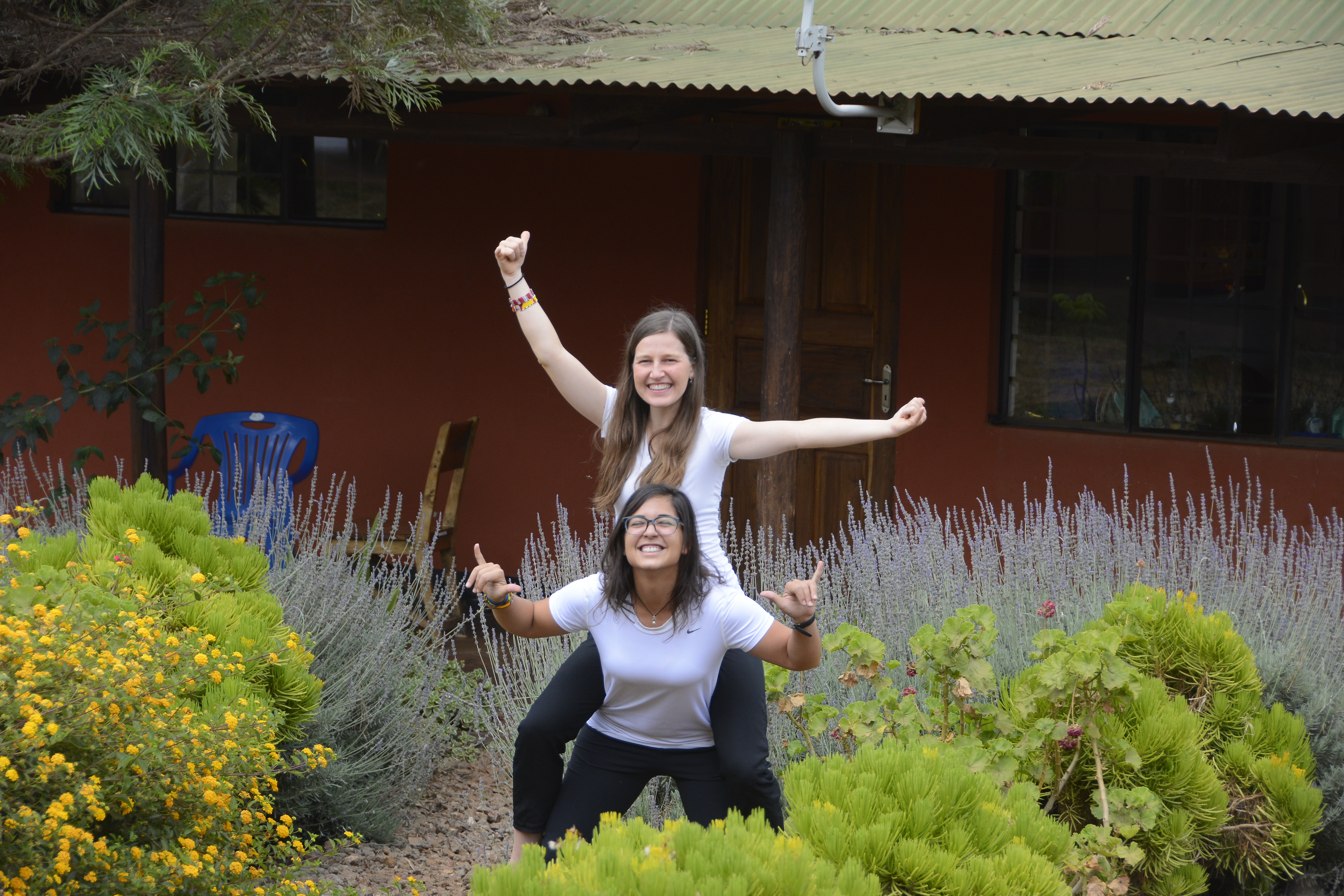
Sara, Neena, Whitley and Simba

We needed that night at Gibbs for tomorrow we would be beginning our six days of FAME Neurology clinic that can often be quite exhausting. I’m sure my three residents had at least a sliver of apprehension not knowing what to expect as they went to sleep that night. Having done this so many times, though, I was again looking forward to the start of this season’s clinic and the interesting patients we would see while also being able to teach the caregivers here.

October 7, 2017 – More interesting neurology along with some others…

Standard

Today was Saturday which is often a much quieter day for us. It was also our last of the unadvertised days that we’d have to work as next week we were having neurology clinics each day, Monday through Saturday, that had been announced in the community by Sokoine and others to let everyone know we were coming. The message is given in churches, community centers and other health facilities along with a description of the types of illnesses we evaluate and treat. Explaining this to potential patients certainly isn’t the easiest thing to get across, but over the last several years, the team here have done a fantastic job of getting the message to those who should be coming to see us and deterring those who shouldn’t be (those without neurologic disease) from coming to see us. They have also made these announcements to some of the villages in more remote areas of Karatu district where we’ll be going the week after for our FAME Neurology Mobile Clinics. This has been our model for the last several years and it has been highly successful in serving a good portion of the neurological population here.

Our young boy with his skull fracture in the right parietal region.

At morning report, we heard of a young 14-year-old Maasai boy who had come in last evening after falling out of a tree and striking his head on a rock, suffering a large laceration that had been repaired at a dispensary, but then his family had brought him to FAME. Whitley hadn’t seen an inpatient consult yet, so she was up for the job to evaluate this trauma and, primarily, neurosurgical case in a place where there are no neurosurgeons and only neurologists, at least for the present. Dr. Lisso showed us the plain skull films that were quite impressive and Whitley was expecting the worse when she went to see him, but he turned out to be neurologically intact other than the fact that we couldn’t really look in his right eye due to the very significant periorbital edema he had that wouldn’t allow us to look at his pupil let alone do a fundoscopic examination.

I sent the X-rays and clinical summary to Sean Grady, Chair of Neurosurgery at Penn, to get his thoughts on the case, though it was 2am at the time so I didn’t expect to hear much until later in the day. The issue was that the family didn’t have money for a CT scan and we weren’t sure that he really needed to get one given his normal examination. We explained everything to his family who seemed to appreciate hearing the results of our evaluation. We heard from Sean later in the day agreeing that given his examination it was safe to watch him and that his fracture would heal by itself. He also confirmed that he was indeed a lucky young man. Unfortunately, he had such significant swelling around his eye, that he was transferred to KCMC (Kilimanjaro Christian Medical Center) the following morning because of concern regarding his vision.

Whitley evaluating a young microcephalic baby with seizues

Whitley evaluating a young microcephalic baby with seizues

Neena evaluating her patient with seizures and blindness

Neena was in her glory when a young man came in who was blind and it was readily clear that he had an issue with corneal scarring. The patient’s mother at first had indicated that he had been blind since about four years of age when he had had cerebral malaria and she thought for sure this was going to be a case of rubella, but the history was incorrect and he had actually had seizures following his cerebral malaria at four years of age. He had not lost his sight until just a few years ago when he had apparently rubbed the sap of the Maanya tree (what the Maasai call it) in his eyes and it had scarred his eyes terribly such that he became blind. Whatever it was, it did a good number on his cornea with severe scarring and he had no light perception. It was still a very interesting case for Neena given her interests, but in the end we had very little to offer for the vision and continued him on his anticonvulsant medication which had been working rather well.

George positioning the baby and providing anesthesia

Neena, Daniel and George assisting with the lumbar puncture

Sara prepping for her lumbar attempt.

A team effort…

Making a last attempt with the lumbar puncture before giving up

Things had slowed down around lunch time and we had decided to try another lumbar puncture on the baby we were concerned had meningitis. Sehewa had been unable to get it last night and we felt it was reasonable to try again as the results would dictate what our recommendations were for length of antibiotic coverage. We checked with Edward, one of the head nurses and backup anesthetist here at FAME, about helping with the procedure and he informed us that they were typically using anesthesia for these short procedures. This was a bit more than both Sara and I were used to, but it really wasn’t our place to tell anyone the what we believed was the right way to do something here so we deferred to Edward and had to wait for everyone to get the newborn prepared for the procedure. It was clearly overkill from our standpoint, but it all went well regardless, at least as far as the anesthesia is concerned. Neither Sara nor I were successful in removing CSF in this manner despite multiple attempts that the baby tolerated well. Meanwhile, we were all exhausted, but the day was over for patients and we decided to run into town as I had to look for some new tires and it was the Maasai Market today.

A sea of mankind that is the Maasai market

The Maasai market is something that takes place in most towns and cities around the country, occurring here in Karatu on the 7th and 25th of each month. I planned to drop off Sara, Whitley and Neena at the Market to wonder around while I went off to deal with my tires. They had a phone so I could reach them when I returned. Unfortunately, I was not successful in getting my tires for when I drove up to Jubilee Tyres here in Karatu, there were two local Land Rovers on jacks having the tires I had looked at the night before being mounted for them. I hadn’t been able to make the decision as I needed to hear back from Leonard and we were texting each back and forth. Luckily, I spoke to the manager of the shop on the phone who assured they would get them in for me next week which was certainly fine. I had four good tires on the vehicle and one bald spare that would have to do on our safari the following days.

In the mass of people, I was finally able to locate my three residents just as they had been intercepted by some street merchants selling their local wares. It can be pretty intimidating as they can be very determined in their efforts to see you something and it’s very hard to break away from them at times. It’s also an art of negotiating here as the price that you finally pay is never what they are asking so it’s pretty much of a game going back and forth to meet somewhere in middle. The longer you hold out on buying something, the lower the price goes and the final prices can often be only a fraction of what the original price had been. The three had a very good introduction into some of the finer points of haggling for wares and ended up walking away with some things they were happy with for reasonable, though not rock bottom prices. The market can be totally overwhelming for even the most hearty of explorers, but the three of them did very well, indeed, and I was proud of them for not having enjoyed the experience.

The market is where all those bales of donated and unwanted clothing from the US end up having been shipped into Dar es Salaam, loaded on trucks and distributed throughout the country just as it is all across Africa. If you haven’t read The Blue Sweater yet, you should. Not that it’s all about the Maasai markets, but it does include the story of the author, who discovered her old discarded sweater while working in Rwanda. Every college, university, state, most high schools, most car companies, and others from the US are represented in the T-shirts and jackets that are sold here from the hundreds of piles of clothes strewn across the ground and being sold by the vendors. Many others are walking around with other items hanging off of them for sale and still others are selling their wares from backpacks and bags. One the young men selling things to us turned out to be Onesmo, a young boy who I’ve known for several years and who has basically now made his life on the street selling necklaces, bracelets, carvings, drums and anything else he might be able to fit.

Neena at the Maasai Market

Our evening ended with a get together at Nish’s home as he had invited many volunteers from the area for food and drink at his house as he would be traveling for three weeks after the 20th. It was again great fun to meet and talk with other volunteers from all over the world who had gathered here in Karatu and the surroundings to do good. We were the only medical volunteers, of course, as most of the others were working at schools, orphanages or microfinance offices. We had to get up early for our safari so we left while the party was still hopping, knowing that we’d be spending the day with the animals at Lake Manyara.

October 6, 2017 – Day two of our “unannounced” neurology clinic….

Standard

Having planned to finish yesterday’s blog this morning, I somehow managed to oversleep. There are some who may not be too surprised by that (I am a champion at hitting the snooze button on my alarm), but I had accidentally turned my alarm off this time so to be completely accurate, it was not a world record at hitting the snooze button. Just the same, I awakened to another gorgeous day outside my windows with a cool morning breeze gently sweeping through my room and against the mosquito netting. The only problem was that I had to be at the clinic in just half an hour and there was a shower to placed somewhere. Thankfully, I am also a champion when it comes to jumping out of bed, showering, getting dressed, drinking a cup of coffee, having two sweet bananas, grabbing my gear and hitting the road. Well, actually it’s just a short walk to the conference room where we hold morning report, so along with the residents (who were up much earlier than me this morning), there was not issue making it in time.

Sara taking a quick break to chart the old fashioned way

There was already a rather animated discussion going on among the staff that was in Swahili and had to do with their maternity program (RCH). After some time, Gabriel apologized noting that they were having a brief staff meeting and felt more comfortable speaking Swahili. It was fine with us as long as we knew if didn’t involve neurology or something we had done wrong, which it hadn’t. Once underway, Dr. Julius, the clinical officer on overnight, went over all of the inpatients from overnight. Again, they had two patients that needed to be seen by us. One, a young adolescent with headaches and syncope and the other, a baby born several days ago at Karatu Lutheran Hospital having seizures the first day of life, the family requested discharge home and then came to FAME when both the baby and mom weren’t doing well. The mom had an infected abdominal wound from her C-section and the baby was now febrile and was looking worse.

Neena, Angel and Baraka evaluating a patient with seizures

Neena examining her patient

It was a slow start to the morning, but things picked up rather quickly and we had a nice stack of charts waiting to be seen. With the little baby in the ward, it worked well to have Sara start there and the other consult was an adolescent so she was going to see both of the consults. Whitley and Neena started on our group of outpatients now accumulating. I had thought perhaps we might actually make tea time at 11am this morning, but that never happened and before we knew it the morning had long passed and it was time for lunch at 2pm. We had been seeing patients straight through for 5 hours without a break. The work is so engrossing though, you don’t even realize the time passing and it’s a general feeling here.

Whitley evaluating Dorthea who has a hemiparesis and seizures and who we’ve seen since 2013

The patients were a bit more typical today – vague numbness, back pain, headache – but they were still quite interesting. Neena saw young woman with a spastic paraparesis that occurred at the age of four who had been completely evaluated at either KCMC or Muhimbili Hospital in the past, but the scans and all the records had been lost when their home burned so we had none of them. It ws very difficult to resist putting her in the scanner here just so we would have our questions answered, but it wouldn’t change her care one bit and we were left with only speculation as to whether she had had an ischemic event, bleed from an AVM or anything else that might have produced her deficits. She had been stable for 15+ years so it certainly wasn’t something that was progressive. She had seizures that we were treating and we would work on that for now.

Neena evaluating a post-ictal seizure patient

Neena also had the opportunity to evaluate a young woman brought in on a stretcher and who was totally unresponsive. This is quite a common event here, to have either someone brought from school or from the fields after having fallen down and were now unresponsive. They are usually woman, though occasionally we’ve had boys come in with this, but I’ve never seen an adult male with it. This young woman was accompanied by her teacher and she had had a similar episode in March when Jamie Podell had seen her, but she had done well since then until we arrived back in town.

Neena’s patient with conversion

Neena went through her exam, which was, of course, normal though her eyes remained closed throughout her time with us and she had absolutely no movements. She blinked to clap, didn’t allow her hand to fall on her face and in general had all the signs we see in a patient who has “fallen out” or “swooned.” She was having another conversion episode. We had treated her with amitriptyline previously as she had also had some headaches and so now we decided to move her up to fluoxetine, a bit more potent of an antidepressant as it was clear she was having some issues with stress being away at boarding school. Neena reassured her teacher along with the patient, who remained “asleep,” but was clearly listening, that she would wake up very soon and be back to normal. I last saw her being loaded into their truck from the stretcher, still unresponsive, but more importantly not being admitted to the hospital as she had been in the past.

Patient with conversion leaving the clinic

Meanwhile, the young adolescent female that Sara went to see in the ward had a very similar story, though also had migraines and what sounded like some orthostatic hypotension contributing to her episodes. She also had a boatload of unresolved issues including previous suicidality that Sara very patiently listened to for some time and which the patient didn’t want her parents to know about making the situation that much more difficult. She also had complained that a teacher had broken her thumb at school so we involved our social worker, Angel, to look into that allegation, but it turned out not to be true and was something that had already been resolved in the past. She also had numbness on the left side of her body that was clearly functional and her examination was otherwise normal. Given the background of stress and unhappiness she was having being away at school (similar to our other young woman) it was not surprising that she could have a large component of conversion to her presenting symptoms, but given her migraines we decided to treat these as well and put her on amitriptyline for the headaches hoping that she would improve.

Sara’s other pediatric consult was the little baby who was about 7 days old and had been seizing since day one, was now febrile and didn’t look very well at all. She had a bit of a bulging fontanelle and a poor suck making Sara very concerned that she might have meningitis. She had not been on antibiotics to cover meningitis, so those were changed and we felt the need to do a lumbar puncture. Beforehand, we had Dr. Gabriel do an ultrasound of the baby’s head to make sure there were no contraindications to doing the spinal tap and there were none. Sehawa, our anesthetist, was going to do the LP, but called later in the evening to tell us that he had been unable to successfully get any spinal fluid so we decided that we’d try again in the morning as the baby was now on the correct antibiotics and it was really to determine the length of antibiotic treatment.

Sara evaluating a prior FAME premie returning for a follow up visit

We finished clinic in time for everyone to return to the Raynes House and relax for a bit with the sun still high and sunset more than an hour away. Everyone was again exhausted and looking forward to some real downtime tonight. In fact, a movie night with popcorn had been planned and the movie was “Lion,” certainly not chosen for the fact that we were residing currently in a region highly populated with this animal, but rather for the wonderful real life story told by this movie. If you haven’t seen yet, it’s highly worthy of your time. Tomorrow would be another day in clinic with more interesting patients, but for tonight we were on idle in our comfortable home where we’d be staying for the month. Sunday will be a day safari to Lake Manyara National Park where hopefully we’ll spot some real lions.

Working on charts in the Raynes House looking towards the back door

Looking towards the front door and veranda

My room in the Raynes House

One of the three other bedrooms

Our view from the veranda

October 5, 2017 – FAME Neurology is open for business….

Standard

Everyone is up bright and early for a breakfast of granola and fruit brought from Arusha as it is impossible to find any decent cereal here in Karatu – the off-brand corn flakes just do not cut it, nor do they hold up in milk meaning it’s a soggy bowl of corn mush by the time you eat it which is generally within seconds. Krazy Kat (KK for short), the orange tabby who is the only remaining member of his family here at the volunteer houses after his mother and grandmother quite likely fell prey to the hyenas often frequenting the perimeter of the property, sits at the window loudly meowing for any potential scraps or a cereal bowl with its remaining milk. He is in heaven lapping up the leftovers.

Neena examining her patient

Neena examining her patient

It’s off to clinic for morning report at 8am where we hear about any new patients that arrived overnight as well as the patients on the inpatient ward and the maternity ward. The clinical officers and doctors discuss the cases in a very collegial, though sometimes boisterous fashion that can be hard for us to follow at times. It is done in English thankfully, though the accents can at times be difficult when several are talking at the same time. We mostly listen for anything that sounds halfway neurological and our ears immediately perk up at the appropriate time. This morning there is a gentleman who arrived psychotic with a history of heavy alcohol abuse and the question is whether we’re dealing with alcohol withdrawal or with Wernicke encephalopathy (thiamine deficiency). The other patient we’re asked to see is on the other end of the spectrum. He is a one-day-old baby whose mother nearly died yesterday after she was unable to deliver the baby due to massive hydrocephalus requiring an emergency C-section.

Sara evaluating her young patient with the spinal tumor

Whitley with her young patient who has suffered from seizures his entire life

Whitley’s young patient

Report lasted unusually long and by the time we get to clinic, there is already a small crowd building. Today was an unadvertised day as we were hoping to begin with perhaps lower numbers so everyone could get used to what’s expected, but apparently some have discovered our presence and have arrived quite early. We have two translators from Rift Valley Children’s Village working with us for the first time today – Emmanuel and Baraka – who will each work with a separate team as we’re seeing patients. As we’ve done in the past, we occupy the night doctor’s office next to the emergency room and the emergency room itself where we’ll have two teams seeing patients with the third resident free to see urgent consults in the wards or other patients in the outpatient clinic seen by one of the other clinicians and now needing our services. This system has worked well and did again today and thankfully the numbers were down a bit as we had planned it.

Sara evaluating her patient with the help of Baraka

It was nice that the numbers were down a bit for several reasons. First, it gave Sara, Whitley and Neena some time to familiarize themselves with the system here – translators, script writing, medications, ordering labs, how to chart, etc. Secondly, the patients we saw today were some of the more complex ones that were all grouped together and we saw none of the simpler cases like back pain, neuropathy or headache. Neena’s first case was 59 year-old woman with complaints of memory loss who had been ordered a CT scan (which she had planned on getting that morning and had a signed script by Dr. Frank for the scan). Her scan was normal as was her examination and it was most likely that her depression was the cause of her memory loss which she didn’t seem to be much too happy about. She had only been on her increased dose of fluoxetine for about a month so we didn’t want to increase it just yet and decided to have her return again in the next month or two to see how she was doing.

Neena’s second case, though, was far more interesting and was a previously diagnosed lumbar Pott’s disease (Tuberculosis of the spine) that had been recently started on therapy and was actually improving. He had had pretty significant deficits in his lower extremities that were much better than they had been based on the history given to us by the patient and a friend. He had been to India for his treatment and imaging and had not required surgery. We had really little additional treatment to offer him other than reassurance that he would likely continue to improve based on his progress so far. Thankfully, he was walking now and would probably do very well.

Whitley and Sokoine evaluating a young Maasai boy

One of Sara’s first cases had a not so optimistic prognosis unfortunately. He was a 19-year-old young man who had been diagnosed with a spinal cord tumor two years earlier involving his mid thoracic region down to his upper lumbar. He had brought his imaging, but only the postop films which didn’t do us as much good and he had total loss of motor activity in his legs and was having to straight cath himself throughout the day as he had no bladder function. The family had brought him to us with the hope that we would tell him he would walk again, but that was not to be the case. His surgery had been done in Dar es Salaam and we didn’t have the pathology nor did they know what it was. He didn’t undergo radiation or chemotherapy so it was probably a more benign process, but either way he would be very unlikely to regain any function. It didn’t seem like the family had heard that before and even though we often feel as though people hear what they want to hear, we couldn’t help feeling that they hadn’t actually been told this by any of their doctors.

Whitley’s first case of the day was a young Maasai boy of about 8 years of age who had been having frequent seizures since he was an infant and had never seen a doctor for them before. It’s difficult to even ask the question of why he had never seen a doctor before without imposing some judgment along the way, but she managed to do so in a very thoughtful and sensitive way that it was very unlikely to have raised any sense of concern by the father. We put the boy on anti-seizure medications that will have a good chance of working since he has never been on anything before.

Sara evaluating her stroke patient on a stretcher

Sara, our pediatric neurologist, evaluated an 80-year-old woman who had suffered a stroke a month ago and had a dense left hemiplegia. She had undergone a CT scan of the brain at FAME the week prior to our arriving and brought the films for us to see when her family brought her in on a stretcher. The scan showed a fair amount of hemorrhage from what looked like hemorrhagic conversion of an ischemic stroke. No stroke evaluation had been done where she was hospitalized at Karatu Lutheran Hospital and Sara noted that her heart rhythm was irregular so we sent her off for an EKG along with some other labs and, of course, the EKG returned showing she was in atrial fibrillation. This wouldn’t have changed anything, but she will eventually need to be on blood thinners to prevent her from having another stroke.

Whitley and Baraka evaluating a patient

Whitley’s day was made when a gentleman showed up who we had previously diagnosed with Parkinson’s disease and was on levodopa-carbidopa with a fairly dramatic resting tremor that involved his entire body. He came in with complaints that his medication wasn’t working well and after a careful history by Whitley, it was clear that his dosing was spread too far apart and needed to be taken more frequently. He had taken his medication a bit before he came to see us and during the visit it was like a switch had been flipped and his tremors were almost all but completely resolved as the levodopa kicked in. He was like a different man. They asked if we had any other medications to treat him with or if the levodopa-carbidopa was the only one at which point we told him that it was the only one available in Tanzania. Dopamine agonists, though useful, would be out of the question here due to cost and it’s unclear whether they are even available.

Sara and a young patient

Well after lunch, both Neena and Sara left to do consults in the wards that had been waiting since the morning. Neena’s patient was an alcoholic who had stopped drinking after falling a week or so prior to being admitted and had become psychotic as he had refrained from alcohol after his fall. He turned out to be a case of alcohol withdrawal and not a Wernicke encephalopathy as we had feared. He didn’t require medications to prevent any worsening and was discharged home no worse for the wear.

Our future neuro-ophthalmologist

Sara’s consult was, unfortunately, not so simple. This baby’s mother had presented in labor and as she was not progressing, an ultrasound was performed. Dr. Gabriel, who I have worked with for many years at FAME, performed the ultrasound and had originally thought he was looking at a large cyst, but soon realized it was the infant’s head with massive hydrocephalus that had not chance of being delivered vaginally. Mom had been pushing for so long that she had almost ruptured her uterus and during her C-section had lost large amounts of blood and if not for the heroic efforts of the doctors would have died. The baby was doing well with apgar scores of 5 and 6, a good suck and a good cry. The baby clearly needed to be shunted to reduce the hydrocephalus, but mom was too unstable to transfer to Arusha. Sara’s evaluation was as expected given the baby’s situation. He was doing well for the moment, but his head was huge with splaying of all of his cranial sutures and a head circumference equal to an average adult. We informed Dr. Gabriel that the baby should be shunted as soon as possible and we agreed that we would contact Arusha Lutheran Medical Center that night or the following morning to transfer the mother and baby to cared for there.

Sara evaluating the young baby with hydrocephalus

Things are never as simple as they seem, though, and we found out the following day that the father of the baby lived in a very remote area of the Rift Valley and could not be to FAME for another two days meaning that the baby would remain at FAME until the father agreed to allow him to be transferred, if, in fact, that would ever happen. Our hope was to save the baby from further disability by delaying the shunt, but in the end, it’s not our call nor should it be.

October 4, 2017 – On to Karatu….

Standard

Traveling across the timeless landscape of the Great Rift Valley, once again on my journey to Karatu and FAME, I am constantly reminded of the history of this region. It is measured not in centuries or millennia, but rather in the millions of years and generations of the human race and our ancestors that have lived here and have gone on to settle the remainder of our planet. This is my Mecca, or my Nirvana perhaps. It is what I have always dreamed of doing with my life and had never believed I would accomplish. And now I am here again, in this magical place where I am not only able to experience something I never thought possible, but I have also been blessed with the opportunity to help others in the process while sharing it with the residents and others I bring with me twice a year.

Having left Arusha midmorning for this trek, we of course were immediately immersed in the midday traffic of this congested city that has far too few traffic lights and far too many motorcycles crisscrossing to and from in front of you while trying to avoid the many pedestrians risking their lives to cross the street. Driving here is not for the timid, that is for certain, and once we find ourselves finally on the other side of town it is clearly a relief. I’ve commented on the traffic police here many times as they do not control traffic, but rather set up stops to check that everyone has the appropriate paperwork with their vehicle in addition to the other essentials such as a first aid kit, reflectors, and a fire extinguisher. As we just break out of town, we are flagged down at the very first stop and I’m asked for my international driver’s license which I thankfully have. I’m asked where were are heading and when I said “Karatu,” he immediately replied “safari?” I told him that we were going to FAME Medical and when he asked me if I was a doctor, I immediately replied “we’re all doctors.” I’m sure he was somewhat taken aback with the three young female residents traveling with me as the culture here clearly hasn’t caught up, but he proceeded to thank us for our service and waived us on without the usually shake down that has happened to me in the past.

Through the town of Makuyuni where we turn right while the main road continues to towards Tarangire National Park and its tsetse flies that Laura and Kelley so enjoyed during our visit there last October. On towards Lake Manyara, where Hemmingway wrote his Green Hills of Africa and his story of hunting rhinos in the 1930s (there are no more rhinos there, of course), and the village of Mto wa Mbu (Mosquito River) that sits at the entrance of the national park there. We slowly climb the escarpment out of the valley with the immense view of the lake and its surroundings behind us and the lush hills that form the Mbulumbulu region and beyond it, the Ngorongoro Highlands that form the rim to the famous crater bearing the same name and one of the highlights of a visit to Northern Tanzania.

Driving down the steep incline from Rhotia, we finally catch a glimpse of Karatu in the distance, a very dusty orange this time of year which is the dry season, but still bustling with more pedestrians than vehicles and the continuous commotion of a commerce that is based on the tourist industry as every safari vehicle heading to the crater or the Serengeti must travel through and resupply here. It is a frontier town reminiscent of the wild west or perhaps Alaska during the Klondike gold rush. There is always that sense that you are journeying into the unknown regardless of how familiar you are or how many times you have traveled forth from here. Perhaps it is that sense of the unknown that has continuously drawn me to this place of wonder.

We finally arrive to FAME just in time for lunch, the highlight of my day here. Maize and beans with a side of mchicha, a delicious dark green vegetable similar to spinach, was being served in the canteen where the entire staff of FAME eats together every day for the midday meal. After lunch it was a tour for the residents with Alex, the volunteer coordinator par excellence here at FAME. After the tour we’re ready to drive the short distance to drop our bags in the house when we discover that one of our rear tires is flat. Another every day occurrence here and something you just have to learn to live with. It usually happens to me once a visit so perhaps this will be it. After jacking up the vehicle, I finally accepted help from Hamsi and several others as each tire and wheel weigh in excess of 75 lbs. Unfortunately, the good spare on the back of the Land Cruiser is held with a lug nut of the wrong size for our wrench and is unable to be used and the other spare has seen better days in another life. Down to one of the tire shops in Karatu, I discover that our flat can’t be fixed, but at least we’re able to free the good spare so I’m good to go for now, but will need to find some good tires to put on before we head into the bush on Sunday. Just another small hurdle to overcome here and something one takes in stride.

I did jack up the vehicle, really!

Relegated to an observer

Wednesday night is now the expat night at Happy Days, a small tavern I have enjoyed since I’ve been coming here and one of the only reasonably priced places to get a decent meal in town. There are many high end lodges, but that’s an extravagance we can only consider a few times during our visit. There are so many young volunteers here in town, working at one of private schools, orphanages or microfinance organizations here. We’re the only medical volunteers, of course, and everyone is half my age or younger. It’s still nice to share experiences with an international crowd and the stories are so varied of what has led everyone to this country. There was a young man there who had been at the American School of Field Studies two years ago and reminded me that I had seen him following a minor head injury back then. I remember him and he has returned here as so many do time and time again. There is just something about this place that gets under your skin and never lets go.

We’re home at a decent time tonight as we have our first day of clinic in the morning and everyone wants to be fresh and rested.

October 3, 2017 – A Day in Arusha….

Standard

The flights here through Doha on Qatar Airways are pretty nice, but I think I had the worst case of jet lag yesterday that I’ve ever had flying in this direction. I’m usually raring to go the day after I arrive and I felt like a slug all yesterday I think. I guess it was the fact that I hadn’t slept on the flight to Doha (just 12 hours) as it really arrived at 11pm east coast time if you don’t count the time change. The problem was that I really couldn’t sleep on the second flight to Kilimanjaro either and in the end, had only two hours of shut eye prior to my arrival here. Considering that we don’t usually eat until very late (nearly 11pm this time), it meant for quite a long stretch without decent sleep and I really felt it. I mostly hung around the house yesterday only going on some short errands with Leonard’s brother, Jones, and otherwise did some reading and relaxing.

Thankfully, I was back on a normal schedule today, albeit seven hours ahead of home. Everyone typically sleeps in a bit here (considering our dinnertime I guess that’s reasonable) so I love getting up early and having some time to myself. The weather here is rather cool in the mornings and doesn’t really heat up until the afternoon. The skies were clear and there was a breeze in the air making for a very pleasant and enjoyable morning. Neena, Whitley and Sara were scheduled to arrive today around 2:45pm which gave me a fair bit of time to spend with Leonard before I had to depart for the airport. Breakfast wasn’t until about 10am (eggs, toast, yams, fresh fruit) so I had plenty of time to catch up on my book (A great read so far – Candice Millard’s The Hero of the Empire about Winston Churchill’s time in South Africa during the Boer War) before heading out with Leonard to run some errands.

I suspect it’s as good a time as any for me to confess my love of all things off-road and especially those involving vehicles in Africa. The Land Rover Defender easily sits at the top of my list and the Toyota Land Cruiser is a close second, though I must also admit that it is really the early Land Cruisers that attract my attention and not the more recent models. Vehicles in Africa are driven until they are close to death and then they are just repaired, over and over again. If a cat has nine lives, then an African Land Rover Defender has double that or more, being repaired time and time again so that every part on the vehicle has been replace at one time or another until all that is left of the original vehicle may be the body, and even then it may have been cut stretched or replaced at one time or another.

A Land Rover Defender pickup truck – a real dream

I accompanied Leonard to see where his brother’s Land Rover Defender pickup truck was being repaired this morning. It is a very long and dusty street lined with one auto repair shop after another. And each shop was as busy as a beehive with climbing on top of, underneath and inside vehicles repairing what would otherwise in the US have been a vehicle destined for the junkyard, or worse yet the car compacter. These vehicles, though, will all survive to drive another mile and see another safari. And there will be smiles on the faces of all those who are fortunate enough to share in the experience.

When we think of recycling at home, it is merely to salvage the raw materials of our everyday use and has a completely different meaning than it does here. Recycling here is the process of continuing to utilize those items that still have some life left in them. Or, to go a step further, it is really the practice that ensures those items still having some life also have some value, thus guaranteeing it’s continued existence. Vehicles are a clear example of this practice, but it really goes far beyond just the obvious. Yesterday, I visited a furniture manufacturer with Jones that uses only old wood to recycle it into beautiful pieces of art that would be worthy of anything we have in the US. He introduced me to the owner of the shop and as we walked outside, the owner pointed to a large pile of old wood and told me that it was about to put into a container and shipped off to the US! So we are now importing recycled wood at home rather than taking the time to collect our own refuse that could be recycled rather than put into landfill. There just seems to be something wrong with that picture.

Errands finished, we were back at home and it was time for me to leave for the airport to pick up the residents who would be accompanying me this trip. The road to the airport has been every changing and now the new four-lane highway heading out of Arusha is almost completely open. Not quite, though, so much as there are still some stretches that are closed on one side requiring vehicles to cross back and forth. In a society where there are no four-lane highways anywhere in Northern Tanzanian, this has created a sort of mayhem so that there are really two parallel two-lane highways with traffic going both directions on each. You never know when a car traveling in the opposite direction might just show up in front you. It is for this reason, I suspect that they have put a 40 kph speed restriction on the road until they get all of this sorted out. For the time being, it just requires a bit of concentration and staying off the road at night.

Having survived at least one direction of my airport trip with nary a scrape, I waited for the three very likely weary travelers to show up. While waiting, though, I was able to assist another travel from the US whose ride hadn’t showed up and was having difficulty reaching his contacts here in the country. We were successful, thankfully, in finally tracking down his transportation, who was only running a bit late and showed up shortly after our call.

Rest for weary….

Neena, Whitley and Sara arrived shortly after, smiles on all of their faces so I was assured there had been no mishaps on the flights or making their connections. Quite relieved that my precious cargo safely in country, it was now time for the trip back to Arusha and having to explain to them not to get too excited if they happened to spot oncoming traffic on our side of the four-lane. Thankfully, there was only one occurrence with plenty of warning so all was well. We arrived home to Njiro, just outside of Arusha proper, where Leonard and Pendo live and everyone settled in. After 24 hours of travel, it was showers first and then while sitting on the couch to talk, I watched as one by one they drifted off to sleep, fully unable to keep their eyes open for one moment longer. They all got a short nap until dinner was served a bit later and then it was off to sleep for them. Tomorrow after breakfast we travel to Karatu and FAME and will begin the our work here in earnest.

Heading home to FAME….

Standard

Every visit to FAME becomes more a part of my life and no longer seems like a trip. I have two homes now and I am merely traveling between them twice a year. I don’t want anyone to think it’s become routine for me, though, for it hasn’t as each time I board my flight to travel to either of my homes there is that sense of regret in leaving one and the anticipation of returning to those I know and love on the other end. It really is a wonderful feeling, to have two lives that are so intertwined yet separate and I am constantly grateful that I have been given this incredible opportunity at this stage of my life and career. I pinch myself every day when I think about it to make sure that I am not dreaming.

As I begin this blog, we haven’t even left US airspace yet as we’re somewhere off the far end of Long Island, with the Hamptons below us and life ongoing as it does every day. I am making my seventeenth trip to Tanzania including the very first to take my kids on safari. The remaining sixteen have been to FAME to bring neurology to a region where there are no neurologists. And what a journey it has been for me. It has been an amazing immersion into the world of global health, international medicine and the culture of Tanzania and East Africa. And along with the fantastic company of all of the residents, fellows, faculty and staff who have also accompanied me this program has grown to become a part of our lives for so many.

Our pre-dawn photo op…Our group of riders

Last weekend, I had the opportunity to participate in an activity that was equally as meaningful and powerful for me as any of my trips to Tanzania. The MS Bike Ride that raises money for MS research and services and travels from Philadelphia to Ocean City, NJ, has taken place for many years now and I had always wanted to ride it with many of my colleagues. Last year, I had planned to, but developed labrynthitis and a subsequent DVT in late summer that required me to be on blood thinners and didn’t allow me to train like I had planned. It didn’t, of course, prevent me from traveling to Tanzania last October fully anticoagulated, but that’s another story. So this year, I was determined to make another attempt. Having never really owned or ridden a true road bike and knowing very little about the ins and outs, I relied heavily on the knowledge of a number of my colleagues to help me find the right bike, acquire the right equipment and then begin to train. I began to ride on weekends and on evenings during the week, sometimes alone and often with our residents or fellows. My mileage increased on a regular basis and with the encouragement of my main training buddy, Kelley Humbert, I was able to tackle 50-70 mile rides out and back from Center City along the Schuylkill Trail to Valley Forge or Phoenixville.

One of our first rest stops

The MS City to Shore bike ride is a 100 mile ride that is thankfully flat for all but the last mile over the bridge into Ocean City and is broken up every fifteen miles or so with rest stops to refill your bottles or backpacks and take on nutrition. There were 6,000 riders in all this year with Penn having the largest team of nearly 400. We had a smaller group of 15 riders that stuck together for the entire ride, stopping at every rest stop together and regrouping as we went along. Many of us were often riding in pace lines, one rider leading and pulling along the others until he was drained and would go to the back of the line. Doing this, we were mostly cruising at speeds of 20-22 mph, often reaching 25 mph. Visions of the Tour de France enter your head for a brief moment until you realize that we’re probably riding at just over half the speed they do on the flats and probably the same as what they do going uphill! I’ll stick with the City to Shore.

One of our last rest stops

We all made it to the finish line together to receive our medals and to be congratulated by all the volunteers there including an old patient of Greg Cooper’s who I hadn’t seen in years and gave me my medal. The Bike Ride raised over 6 million dollars and is the second largest fundraiser for MS in the world. We all stayed in Ocean City that night and were fed the most amazing meal by Julie Suter’s Grandparents, Bob and Mary Anne Suter, who were such incredible hosts for near 20 of us including friends and spouses who hadn’t ridden. I returned home the following morning by bus, while several of the group rode the additional 80 miles home and the remainder spent a beautiful day on the beach in Ocean City.

Close to the finish line

For Kelley Humbert and Laurita Mainardi, though, there were other things on their minds during the ride. They are both Puerto Rican and their families back home were, at that very moment, dealing with the horrible devastation of hurricane Maria that had made a direct hit on the island, denuding the forests, destroying homes and bringing the infrastructure of an already crippled economy to it’s knees and even worse. These US citizens were left without water, food, power, gasoline, health or even a means to reliably communicate with their families on the mainland. It has now been a week following this massive destruction of the entire island and we are little closer to providing the support and rescue efforts deserving of our fellow countrymen and women. This travesty has played out before our eyes and so little to date has been done to correct it by our current administration when it should only require a fraction of our resources to go in and provide support.

I think they enjoyed their stay

Kelley and Laurita are providing one mechanism for each of us to contribute something towards this cause, though, by creating a GoFundMe site to raise money for Puerto Rico. They have created a metric century bike ride to benefit Puerto Rico to which anyone can contribute whether you intent to ride or not. The ride is in late October, so I will not be able to participate, but I have contributed as it is a worthy cause and no one should delay in checking it out and giving whatever you can at this time.

https://www.gofundme.com/CenturyForPR

So I will be arriving into Doha in about ten hours and catching my next flight for Kilimanjaro, arriving there on Sunday afternoon. I am looking forward to visiting with my Tanzanian family for a few days before the residents arrive on Tuesday. Neena Cherayil, Whitley Aamodt and Sara Fridinger will be accompanying me at FAME for this visit and I’m looking forward to introducing them to the amazing clinic that is FAME Medical, to the wonderful people of Tanzania and to my other home that I have so come to love over the last eight years.