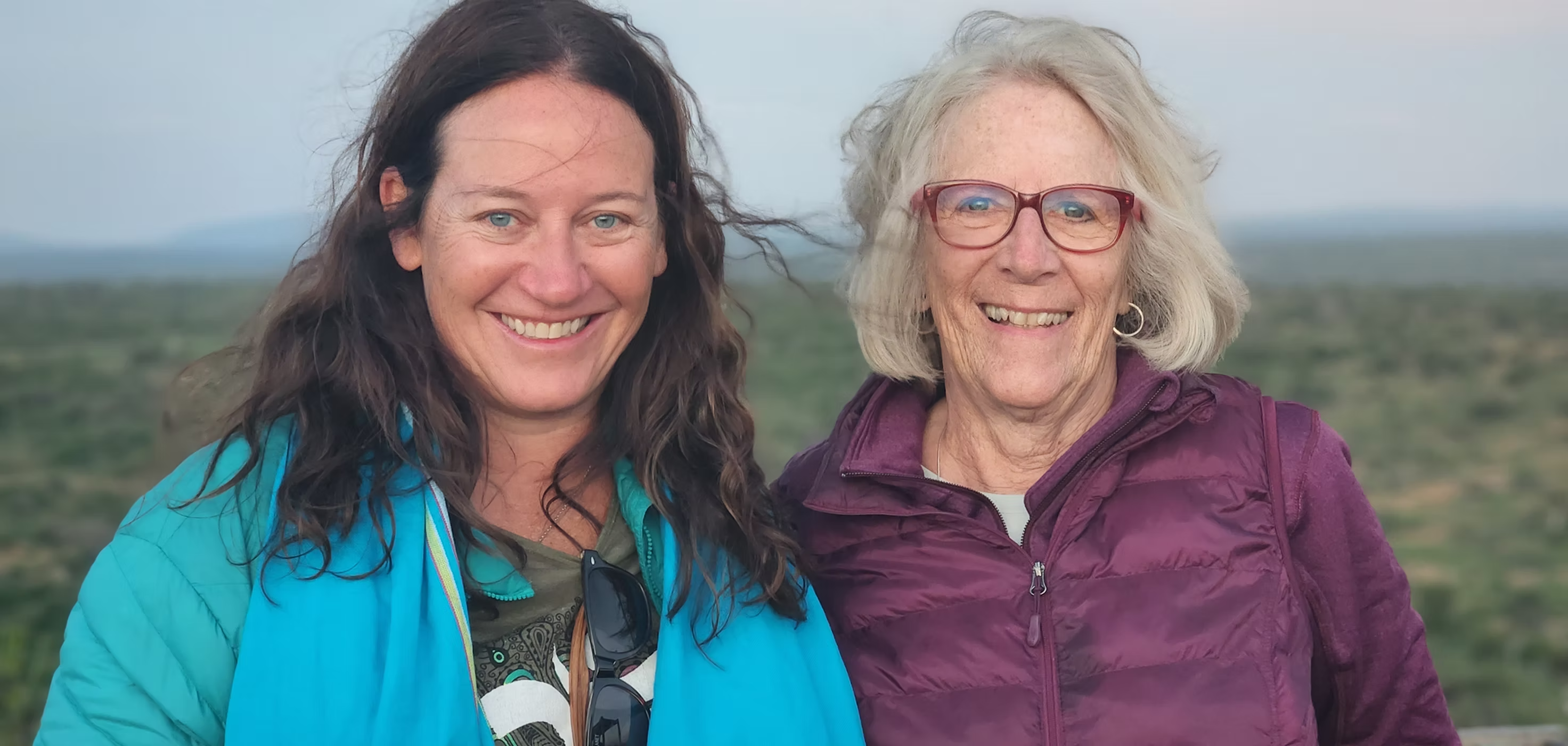
from us (Guess what fellowship he’s going into?)
Our second and third mobile clinics for the week would be to the Rift Valley Children’s Village (RVCV) and the Oldeani Area. The Children’s Village is a magical place in and of itself, though it has also played a significant role in the history of FAME and where it is located. This history of RVCV begins in 2004 when India Howell (Mama India) and Peter Mmassey opened the children’s village to serve as a home, rather than an orphanage, for a handful of vulnerable and orphaned children who would no longer have to worry about who their family was nor whether they would be adopted by a stranger for they already had been taken in by Mama India and Peter. This core group would become the cornerstone of an ever-increasing family that now numbers well over 100 children with the oldest of them having long ago attended college and are now creating families of their own.

After Frank and Susan decided to move to Tanzania with the vision of creating FAME, Frank began working in the Usa River area just outside of Arusha with a general practitioner to begin retooling himself as a primary care doc given all his background had been in cardiac anesthesiology. As the expat community here is rather tight, once India had met Frank and Susan, she began driving her kids to see Frank in Arusha, which was before the highway had been completely paved so it was a four to five hour drive each way at a minimum. It was India who had suggested to them to consider locating in Karatu for several reasons, not to mention that it would be tremendously closer for her to get her children’s care. It was also close to the Ngorongoro Conservation Area and the massive Maasai population living there that was desperately in need of quality health care. Lastly, Karatu was the last outpost of civilization before heading off to the Serengeti and every safari vehicle had to travel through town such that it was likely that FAME could provide care also for the tourists traveling through and that could be a potential for fundraising as well.

FAME first opened its doors in 2008 – there was only an outpatient building at that time with only several doctors, including Frank, and there was a huge emphasis on outreach to the Karatu district so that residents would be aware of FAME. During the early years of RVCV, India had come to realize that it was crucial that she not only provide excellent health care for her own children at the village, but it became increasingly clear that unless the local village children who her kids spent the day in school with were also healthy, it would all unravel and her children would come home sick. The philosophy of providing health care to the residents of the community where her children lived came about and that care was provided by FAME. When I first came to work in 2010, FAME was providing twice monthly medical clinics at RVCV in which several doctors and nurses would travel there to hold a clinic over several days. I participated in those initially, but eventually we piggybacked onto those clinics and held a separate neurology clinic on the same days.

Over time, though, and as FAME continued to grow, it became more difficult to supply the manpower necessary for the medical clinics at RVCV, and it also became clear that patients from the community and the children’s village could be transported to FAME for their care and it was less costly. For neurology, though, we continued to maintain our mobile clinics at the children’s village given the number of neurology cases there that needed our care, and we have continued to maintain those clinics at the same frequency. Today, there is a beautiful health clinic just outside the children’s village that was recently built and is run by Africanus, a wonderful clinical officer who began his career in the Karatu district volunteering with the neurology clinic at FAME as a translator, later hired to work at FAME, and finally hired by the Tanzanian Children’s Fund (TCF), the overarching organization that fund’s the children’s village, to provide health care to the residents of that community and work in partnership with FAME for any patients who required more advanced care.

In addition to the children’s village, TCF oversees several other initiatives in the community that includes collaborative efforts with education – funding additional teachers for the primary schools, lunch programs for the secondary schools, and now dormitories for the secondary schools – as well as providing microfinance and supporting the Rift Valley Women’s Group in which women are provided training for a number of vocations such as making clothing, jewelry, and other items that are then sold throughout the region to provide income for their families. So, essentially, there are the four arms of the TCF – education, healthcare, microfinance (the Women’s group), and the children’s village.

This now brings us to the African Massage Road, as the road to RVCV once leaving the tarmac is known by. The children’s village sits in the Ngorongoro Highlands and the foothills of Mt. Oldeani, backing up to the conservation area and in the middle of some very huge coffee plantations. Most of the residents of Oldeani community are coffee pickers or farmers as there is very little other industry there. To reach the African Massage Road, you travel about twenty or so minutes on the tarmac from Karatu in the direction of the Loduare Gate that leads into the conservation area. The turn to RVCV off the tarmac is marked by a wooden sign preparing you for what is to come over the next kilometers. Regardless of the warning, though, this is simply one of the most gorgeous drives one could ever imagine. The road travels along a ridgeline for several kilometers with huge farms to the left and a deep valley to the right with numerous thatched roof homes of the farmers dotting the hillside.

The drive for several kilometers along the ridge is fairly mild, unless of course it has been raining, in which case the path is quite slippery, and the vehicles tend to buck and shift with the ruts in the road. At the end of the ridge, there is a sharp right hand turn that leads directly down a steep grade – in the dry season, this is just dusty and bumpy, but in the wet season, and especially if it has just rained, the path is genuinely like a slip and slide, and as long as you have it in low gear and don’t touch your brakes, you’ll be in good shape. We were in good shape today as the road was dry with very little dust and it was just a matter of bouncing down the hill. Once at the bottom and in the valley, you immediately begin a steep incline that requires low gear to make it to the top as it’s incredibly rocky and there is very little in the way of traction. The Land Rover (I’m driving Turtle with our neuro team including translators) has all-time four-wheel drive, so other than shifting into low gear, there is little else to do other than hold on and climb.


We crest yet another ridge and head back downhill once again towards a gorgeous rushing stream that thankfully has an intact bridge, and then it’s uphill once again. This climb is where I had first driven in East Africa when one of the staff was trying to get our vehicle started uphill and, when repeatedly unsuccessful, I offered to drive and was quickly taken up on my offer. I was a kid in a candy store, never having believed that I’d be driving in such a place – that was in 2011. Having now driven for the here for the last fifteen years, it is no less exciting for me, and I have to pinch myself constantly to make sure I’m not dreaming. Once up this hill, we’re on a high plateau filled with coffee plants before arriving at the children’s village gate.

Upon entering, there is an immediate sense of serenity that is unmistakable. Though the clinic is now outside of the village gate, I still park in front of the administration building out of a sense of habit as this is where we held our clinics for so many years and walking to the other side, you immediately find yourself in the heart of a home that is like no other. Africanus met us as we entered and brought the team over to the cantina as the mamas had apparently made breakfast for everyone. I headed over to the clinic, though, to leave my bag in the office, only to find that there was a young boy who had been having repeated seizures since earlier. I walked back over to the cantina to make sure everyone knew that we had work to do, though was unaware that everyone had actually been invited to have breakfast – it was a bit confusing, though thankfully, Shannon came over to the clinic to help out with the child, who was by now postictal, and eventually woke up just fine.

It was a hectic start to the day, and we ended up with 30+ patients seen which was a lot with only three residents sharing the burden. Many of these patients are follow up epilepsy patients, though we also had quite a few new patients. The day ran so long for us, that we ended up with patients from the village of Oldeani that missed their rides back to town, which was not necessarily on the way home, but also wasn’t totally out of the way either. After volunteering to take them to Oldeani, Omari, who was driving Myrtle, offered to drive them home instead which was a relief as we were all pretty exhausted. As it was, we were getting home after sunset.