

Yesterday, the world mourned the loss of a giant. Jane Goodall, whose storybook life began among the chimps of Tanzania and carried on as she became perhaps the strongest voice for the preservation of nature and the wildlife who inhabit it, died yesterday at the age of 91 of natural causes while on a speaking tour in California. Her life became known to many of us through her early monumental work after she was initially hired by Louis Leakey in 1960 to study the chimps of Gombe Stream with significant funding through the National Geographic Society, but it was her continued life-long passion as a conservationist that brought her to the world’s stage and known to millions of children worldwide through her Roots and Shoots program. Simply put, she was a giant among giants.


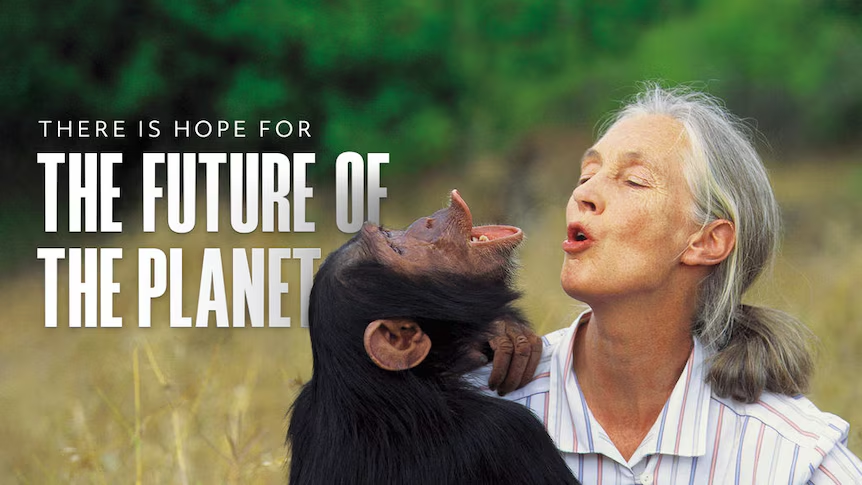
I had first become familiar with her through my love of the National Geographic Society as an adolescent, having visited the society’s headquarters in Washington, D.C., in 1969 with my brother, and found myself enthralled with the many explorers and expeditions that the NGS funded, among them the work at Gombe Stream. Her first book, My Friends, the Wild Chimpanzees, was published by the NGS in 1967, and a first edition of that book, has remained in my book collection for over fifty years. The premise for my first visit to Tanzania in 2009, along with my two children, Daniel and Anna, was, in fact, that Anna had an interest in working with animals and going to school for wildlife management (just as a side note, Anna is now a senior at UC Davis School of Veterinary Medicine and will be graduating in May).


As part of that love, Anna had worked as a junior docent at the Elmwood Park Zoo, in nearby Norristown, while in high school, and during that time, we had the privilege to have met Jane Goodall, as she had come to the zoo for a Roots and Shoots activity. In addition to bringing my camera, I had given Anna my first edition copy of My Friends, the Wild Chimpanzees, to have Jane possibly sign it for her. We had a front row seat, actually standing to the side of Jane as she spoke to the gathering of children, and at one point, was presented with the zoo’s huge Bald Eagle, who had been rehabilitated after an injury and still remained at the zoo. Jane, who was fitted with a gauntlet, or raptor glove, to protect her arm from the eagle’s talons, held the bird, who seemed to be almost half her height, while I found myself to be the only one nearby with a good camera and began snapping photos. I gave them all to the director of the Zoo who was good friends with Jane, and thankfully, I was able to retrieve many of them from Kim, who keeps things orderly on her computer.


The best moment, though, came as Jane was going to meet alone with all the junior docents, and as Anna, her book under her arm, was led to a conference room, I recall one of her support staff saying, “no book signings, please.” Jane immediately noticed the book Anna held, and quickly commented, “except this one.” What a moment. Though there were no parents in the meeting between the docents and Jane, I learned later that she happily signed the book to Anna and also had a few questions for her.


It was over ten years later, after having come and gone from Tanzania perhaps 18 times as part of my work with FAME, that I once again felt a similar connection with Jane Goodall and her life work when I traveled to Gombe Stream National Park to visit her chimps with two of my colleagues. Mike Baer, now a neuromuscular attending at Penn, Leah Zuroff, currently an MS fellow at UC San Francisco, and I had decided to spend several days at the Jane Goodall research facility which is the original site where she had spent those first years with the chimps virtually on her own. Much of the original structures, including her house, still exist at the site, though it is now the temporary home for many student researchers, guides, trackers, and rangers. It was a truly magical visit as many of the paths and trails we took in search of the chimps were those that had been used by Jane so many years ago, and many of the more important locations in the hills still have the names that she originally gave them attached. I recall one morning sitting on “Jane’s point” and looking out over the lush vegetation just as she must have done, listening for the sounds of the chimps echoing through the valleys below.

They were strenuous hikes for sure, as we had to travel far into the interior to find the chimps due to our visit during the dry season, but with the help of our guide, and the trackers who had been out in the pre-dawn hours, we were able to visit and follow several of these incredible families, some with babies, and all known by name for those who spend time with them. It’s hard to describe the sense one gets standing under a tree in which there may be a dozen chimps from one family, all interacting with such behavior that it would be clear to anyone observing that these beings are clearly our closest living relatives. As they decided to move on and climb down from their tree, they walked right past us, easily within a foot, and it only took one look into their eyes to realize just how human they are, or rather just how much we are like them. It would be impossible to have spent those days literally in the footsteps of such a giant without its having left a profound and lasting effect. As an added treat, we visited Jane’s home at Gombe Stream during our visit and met one of the researchers who had spent years with her including helping to arrange her travels in Tanzania. Sitting in her living room in one of the several armchairs that she had likely spent many evenings in previously, looking around at all the research material, it was impossible not to have imagined the incredible and important discussions that had occurred in this place over the years past. With a past of having worshiped explorers and anthropologists, my visit to Gombe Stream was, to say the least, deeply moving.

Meanwhile, it was time to get back to our current work – after nearly a month with not to many volunteers other than neurology here, we’ve had to come up with additional topics for our educational talks. As it seems that coming up with neurology pathways has been one of the themes of this fall’s visit, Leah, who just arrived several days ago, gave a talk this morning that presented an algorithm for when you should be considering an CT scan when evaluating a patient. Though this is an incredibly important topic at home as unnecessary imaging studies pose a huge burden on the cost of healthcare, it seems equally significant here as these studies are being performed as self-pay given the fact that the vast majority (essentially 100%) of our patients do not have national health insurance and are paying fee for service. The fact that we even have a CT scan available here at FAME is somewhat of a miracle, and though it has assisted in the diagnosis and treatment of a great number of patients that we see here, it has also created a great tendency to over rely on it which has to be avoided at all costs. We very rarely perform what I refer to in the US as “therapeutic scans,” that is to allay a patient’s underlying anxiety, here at FAME, and the likelihood of one of the CT scans here being abnormal is far greater than it is at home.


Our patients today were quite diverse and ranged from catatonia or psychomotor slowing in a depressed person, to a young boy in status epilepticus, to a child who we had treated for infantile spasms and was now returning. Though the patient with severe psychomotor slowing that looked pretty much catatonia, wasn’t necessarily a neurologic patient, I’ve outlined in the past how we have become the de facto psychiatrists very often here. We evaluated the patient and based on their history, elected to start them on a benzodiazepine trial to break their catatonic state and also started fluoxetine, an SSRI medication for depression. We asked him to come back in several weeks to see if the benzodiazepines were helping as that is not a medication for them to stay on long term, as opposed to the fluoxetine.


The child with the history of infantile spasms when we had seen them three weeks ago, had been placed on high dose steroids which is the treatment for this condition, a most often devastating epileptic condition of infancy that leads to severe developmental delay in most of the cases regardless of whether treatment is initiated early or not. There is also a very specific EEG pattern that is seen in these children, called hypsarrhythmia, that consists of very high amplitude, severely disorganized and chaotic slow waves and spikes. The treatment with high dose steroids will very often cause resolution of the abnormal EEG, though not necessary arrest the process leading to developmental delay. When the child came to clinic, the family reported that their seizures, or spasms, had become much less frequent and there was some hope that the child would respond, though again, it was unclear what the long-term prognosis would be. We considered obtaining an EEG on the child, but unfortunately, the smallest Brain Capture electrode cap was too large for the child, so we would have to rely on clinical impressions.


Another interesting patient we were seeing for the first time was a young 14-month-old Massai girl whose mother brought her in as she seemed to have a right gaze preference that had started only one week prior. The child was otherwise entirely healthy with a perfectly normal neurologic examination except for her eye movement that revealed she had a left VIth cranial nerve palsy (meaning that she was unable to abduct her left eye or move it outward. As a result, she was turning her head to the right volitionally so that she wouldn’t see double. The VIth cranial nerve is unique as it has the longest intracranial course of any of the cranial nerves making it the most vulnerable to increased intracranial pressure or to trauma, though can also occur not uncommonly as a congenital abnormality, though mom was very certain that it had only began a week prior. The child had not suffered trauma and looked to perky and well to have increased ICP, so the other causes could include a mass lesion, again felt less likely in the absence of other neurologic deficits, or perhaps a viral event causing a parainfectious inflammation of the nerve. Our decision was to watch the child for now and have her return in two weeks to see if there was any improvement in her condition. Having only a CT scan, as opposed to an MRI, left us somewhat wanting as the former would be much less sensitive looking for a cause of the palsy if it was needed in the end.

We were just about to head home when we were consulted from the emergency room for a six-year-old boy who had been having seizures since July that had been infrequent but was now presenting with multiple seizures over several days without complete return to normal that was consistent with status epilepticus. We loaded the child on sodium valproate, orally as we have no IV formulation here, and felt comfortable that would very likely control his seizures quickly, which it did as he hadn’t seized again by the following morning, and was discharged home on a good standing dose of the medication to prevent further seizures. There were no other features that raised concern that would have required further workup for the child.

Once we made it home, it was a quiet night for the group. We were invited tomorrow night to Frank and Susan’s house for bites and sundowners along with the rest of the volunteers here at FAME.
Michael – What a terrific tribute to Jane Goodall. Thank you for sharing those stories. Love the picture of Anna and Ms. Goodall at the Elmwood Park Zoo! All the best, Mark Ehlers
Mark – so great to hear from you and hope all is well. Mike
Dr R
Can you please figure a way to do a shout to ELYSSA, Judy will really enjoy it…..thanks….R